
Process Monitoring
Your Boiler Is Burning Thousands of Rupees Every Month: Here's How to Stop It
Introduction
Every plant with a boiler pays for fuel. Very few know how much of that fuel actually turns into steam.
The rest escapes through the chimney as hot gas, or is lost to soot, scale and unburnt fuel. The good news is that this loss can be measured, and even a small efficiency gain adds up to lakhs of rupees a year.
In this blog you will learn:
- Why boiler efficiency monitoring saves fuel and money
- How a flue gas efficiency monitor works, in simple terms
- What reduces boiler efficiency, and by how much
- The right way to monitor your boiler
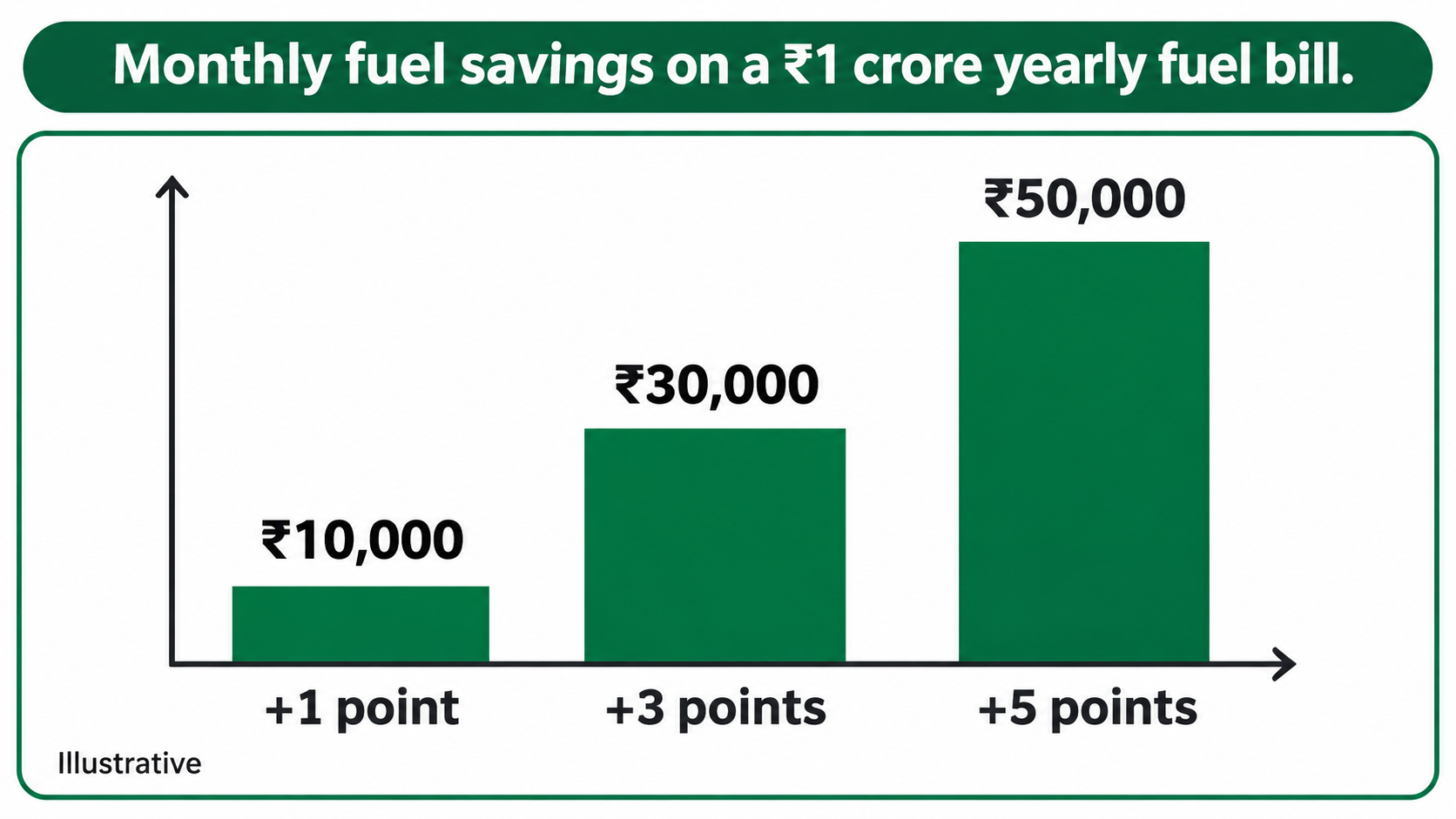
What this means in rupees
| Efficiency gain | Fuel saved | Savings on a ₹1 crore yearly fuel bill | Savings on a ₹5 crore yearly fuel bill | |
| 80% → 81% (1 point) | about 1.2% | ₹1.2 lakh a year (about ₹10,000 a month) | ₹6.2 lakh a year (about ₹51,000 a month) | |
| 80% → 83% (3 points) | about 3.6% | ₹3.6 lakh a year (about ₹30,000 a month) | ₹18.1 lakh a year (about ₹1.5 lakh a month) | |
| 78% → 83% (5 points) | about 6.0% | ₹6.0 lakh a year (about ₹50,000 a month) | ₹30.1 lakh a year (about ₹2.5 lakh a month) |
Illustrative figures. Fuel saved = 1 − (old efficiency ÷ new efficiency), the same formula the US DOE uses. [2] Replace the fuel bill with your own to see your number.
You cannot improve what you do not measure. That is where flue gas monitoring comes in.
How Does a Flue Gas Efficiency Monitor Calculate Efficiency?
No formulas needed. There are two ways to measure boiler efficiency.
- Direct method: compare the steam you get with the fuel you burn. It needs accurate fuel and steam flow readings, and gives you one number without the reasons behind it.
- Indirect (heat-loss) method: find out how much heat is lost, mainly up the stack. Whatever is not lost is your efficiency.
A flue gas efficiency monitor uses the second method. It works in four steps:
- Sample. A probe draws a small sample of hot gas from the stack.
- Measure. Sensors read oxygen (O₂) and carbon monoxide (CO). A temperature sensor reads the stack temperature. CO₂ is calculated.
- Understand. O₂ shows how much extra air passed through the boiler. CO shows whether fuel is leaving unburnt. Stack temperature shows how much heat the gas carries out.
- Calculate. The instrument combines these readings with the fuel type, works out the heat lost and shows your efficiency.
BEE lists the same readings for the heat-loss method: the percentage of O₂ or CO₂, the percentage of CO, and the flue gas temperature.
In plain words: more extra air and a hotter stack mean more heat lost and lower efficiency. Stack readings capture the biggest loss. Smaller losses, such as radiation and blowdown, are added for the full boiler efficiency.
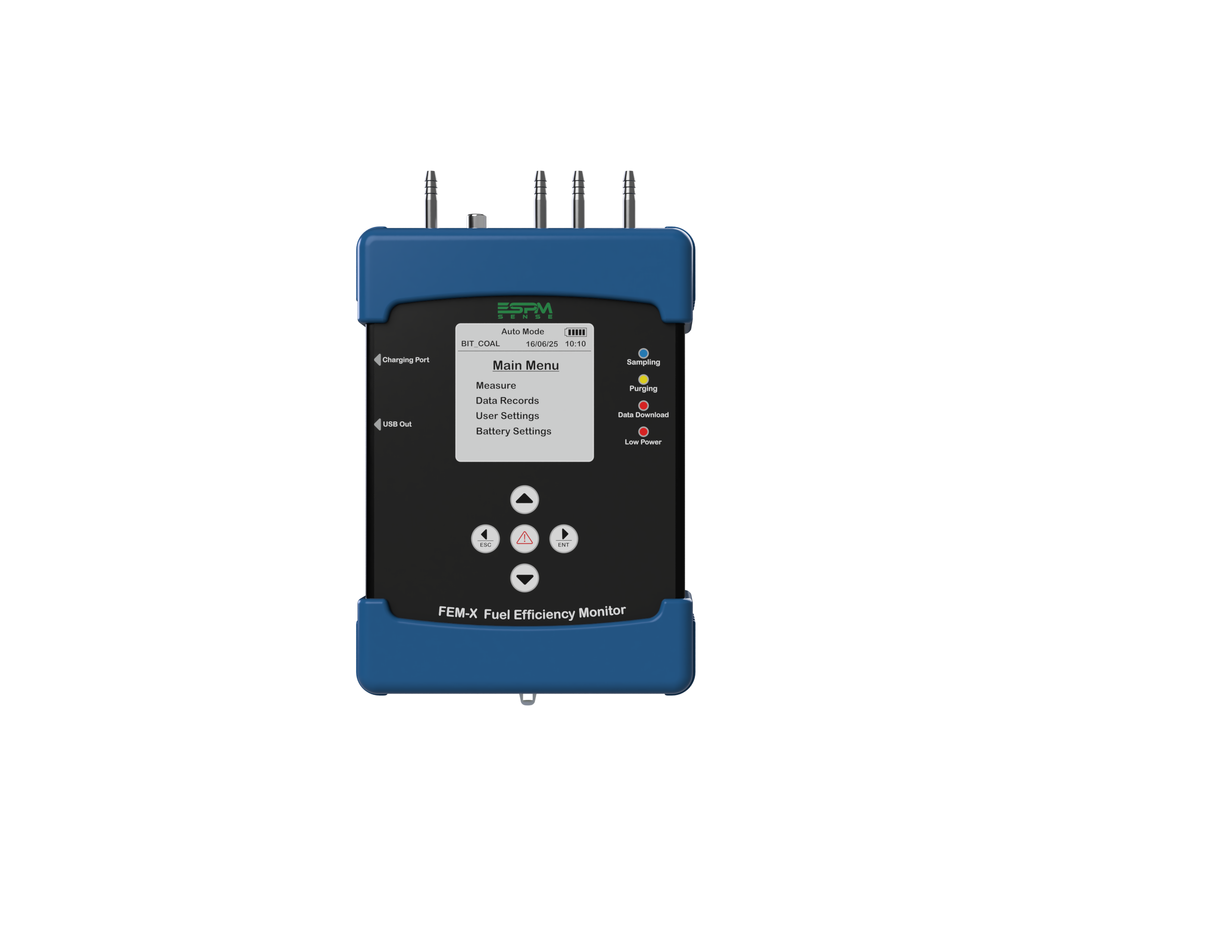
Where FEM-X fits: ESPM Sense's FEM-X is a portable Fuel Efficiency Monitor built for this job. You choose the fuel from 26 preloaded options (plus 3 user-defined), connect a low-temperature (0–600°C) or high-temperature (0–1100°C) probe, and read the results on the display. Depending on the variant, it measures O₂, CO, SO₂, NO and NO₂, with CO₂ by calculation.
What Affects Boiler Efficiency?
| Factor | What goes wrong | Typical impact | |
| Too much excess air | Extra air carries heat up the stack | About 1% efficiency per 5% cut in excess air (BEE) , or per 15% (US DOE, more cautious) | |
| Too little air | Fuel burns incompletely, leaving CO, soot and unburnt fuel | Wasted fuel and raised CO | |
| Hot stack | More heat leaves with the flue gas | About 1% per 20–22°C | |
| Soot on the fire side | Insulates the tubes, so more heat goes up the stack | 3 mm of soot ≈ 2.5% more fuel | |
| Scale on the water side | Insulates the tubes from the water | 1 mm of scale ≈ 5–8% more fuel | |
| Wet or poor-quality fuel | Part of the fuel's energy goes into drying it | More fuel for the same steam | |
| Blowdown | Hot water is discharged | About 3–4% loss |
Most of these problems show up in three readings: O₂, CO and stack temperature. Soot, for example, stops heat reaching the water, so more of it leaves through the stack. [8] That is why the stack is the best place to check a boiler's health.
The Right Way to Monitor Boiler Efficiency
- Set a baseline. Test at full load and at part load, and write down O₂, CO, stack temperature and efficiency. The US DOE recommends testing at both.
- Measure on a regular schedule. Use the same sampling point, a steady load and the correct fuel setting, so readings can be compared month to month.
- Log every reading. Trends tell you more than single readings. Boiler logs were among the simple practices the Indian audits recommended for spotting inefficiencies.
- Act on the numbers. High O₂: reduce excess air. High CO: check the burner and air supply. Rising stack temperature: inspect for soot and scale. For natural gas, the DOE says an efficient burner needs only 2–3% excess oxygen, and higher readings deserve a closer look. Other fuels run higher, so ask your boiler supplier for your target.
- Re-test after every tune-up or cleaning. This confirms the gain. High-efficiency tune-ups guided by flue gas analysis typically save 4–5% of fuel and often pay back in under a year.
- Cross-check occasionally with the direct method (fuel in, steam out).
- Keep records audit-ready. Energy audits by accredited auditors are mandatory for designated consumers under the Energy Conservation Act, 2001. Dated readings make audits easier.
The US DOE recommends a handheld flue gas analyser for any boiler with a yearly fuel bill above about US$50,000 (roughly ₹40 lakh and above).
Making It Easy with FEM-X
Quick FAQs
- What is boiler efficiency monitoring? It means regularly measuring flue gas O₂, CO, CO₂ and stack temperature to find out how much of the fuel's energy becomes steam, and where the rest is lost.
- How often should I check boiler efficiency? A practical approach is a regular monthly check, plus a test after every burner service, fuel change or cleaning. Larger or heavily loaded boilers benefit from more frequent checks.
- What is a good boiler efficiency? It depends on the fuel, design and age. Older systems often run at 60–80%, while the tuned gas boiler in the DOE example reached 83%. Compare your readings with your boiler's design value.
Conclusion
Your boiler's stack tells you a lot. Measuring O₂, CO and stack temperature regularly lets you tune the air supply, catch soot and scale early and cut fuel use. On a ₹1 crore yearly fuel bill, even a one-point efficiency gain is worth about ₹10,000 a month.
Start with one baseline reading this month, then track it. Small, regular measurements are what turn a hidden loss into savings.
Want to see where your boiler stands?
Talk to ESPM Sense about FEM-X: +91 7486032013 | sales@espmsense.com | www.espmsense.com
References
- Kondik, D. J., Maintenance Strategies for Boilers and Water Heaters, Facilitiesnet (2016): https://www.facilitiesnet.com/hvac/article/Maintenance-Strategies-for-Boilers-and-Water-Heaters--16455
- US DOE, Steam Tip Sheet #4: Improve Your Boiler's Combustion Efficiency (2006): https://www.nrel.gov/docs/fy06osti/39308.pdf
- Good Business Lab, Is India's energy transition failing its MSMEs?, India Development Review (April 2026): https://idronline.org/article/ecosystem-development/is-indias-energy-transition-failing-its-msmes/
- Bureau of Energy Efficiency (BEE), Energy Performance Assessment of Boilers: https://beeindia.gov.in/sites/default/files/4Ch1.pdf
- BEE, Checklists and Tips for Energy Efficiency in Thermal Utilities: https://beeindia.gov.in/sites/default/files/2ChAnnexure.pdf
- Forbes Marshall, Monitor flue gas temperatures to control stack loss: https://www.forbesmarshall.com/energy-conservation/monitor-flue-gas-temperatures-to-control-stack-loss/
- BEE energy conservation tips for industries (via WBSEDCL): https://portalq.wbsedcl.in/irj/go/km/docs/internet/new_website/pdf/Energy_Conservation/TipsforEnergyConservationforIndustries.pdf
- Forbes Marshall, Avoid soot deposition on heat transfer surfaces: https://forbesmarshall.com/Knowledge/Energy-Conservation-Tips/Steam-Utilization/Tip-Energy-Conservation-Avoid-Soot-Deposition-on-Heat-Transfer-Surfaces
- US DOE, Steam Tip Sheet #24 (burner efficiency): https://docs.nrel.gov/docs/fy04osti/33470.pdf
- Consulting-Specifying Engineer, Cost-effective boiler system retrofits: https://www.csemag.com/cost-effective-boiler-system-retrofits/
- BEE, Enforcement Machinery under the Energy Conservation Act (presentation): https://beeindia.gov.in/sites/default/files/Enforcement%20Machinery%20PPT.pdf